A washer that won't drain is most often clogged at the drain pump filter or coin trap, the drain hose is kinked or blocked, or the house standpipe is backing up. A failed drain pump or a lid lock fault comes next. Unplug the washer, bail out the water, and check those spots before calling for a pump or control repair.
Before You Touch Anything: Power and Water
A washer full of standing water is heavy and electrical, which is a bad combination for hurried troubleshooting. Unplug the washer first, or switch off its breaker if the plug is hard to reach. Turn off the hot and cold supply valves behind it so it can't refill.
On a front-load machine, don't try to force the door open with water above the bottom of the glass; most stay latched until the drum is empty. You'll drain it through the pump filter instead. On a top-load, bail water out with a cup into a bucket and soak up the rest with towels. Wear gloves; standing wash water can be dirty and smell strongly.
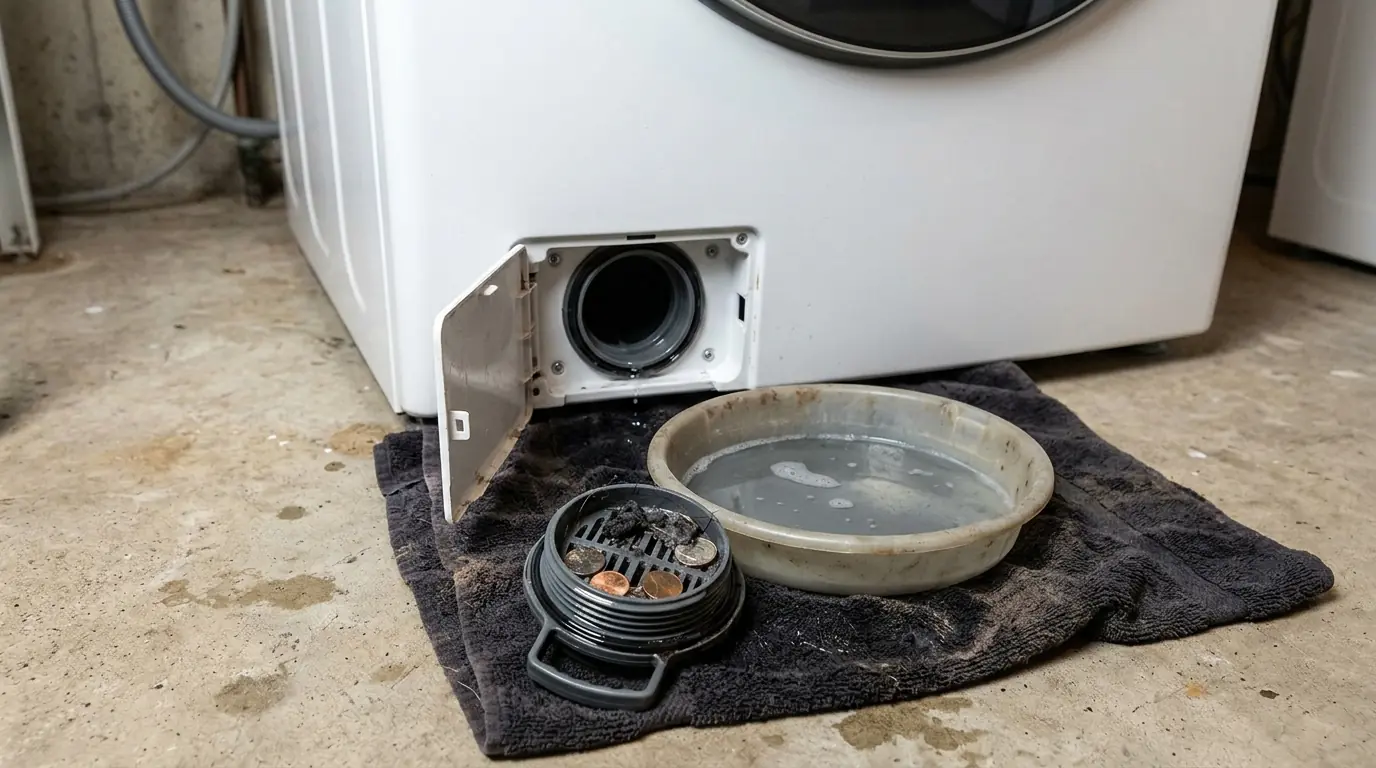
Front-Load Washers: The Pump Filter and Coin Trap
Most front-load washers have a small access door at the bottom front corner. Behind it is the drain pump filter, sometimes called the coin trap, plus a short drain tube. This is the single most common fix for a front-loader that won't drain, and it's designed to be serviced by the owner.
Lay towels down and set a shallow pan in front, because water will come out faster than you expect. Pull the small drain tube first and let the water out in stages, then slowly unscrew the filter. You'll often find coins, hair ties, buttons, small socks or a mass of lint. Rinse the filter, clear the opening, check that the pump impeller spins freely by hand, and screw the filter back in snugly.
Top-Load Washers: Hoses and Hidden Clogs
Many top-load washers don't have a user-accessible filter, so a clog usually lives in the drain hose or in the pump itself. Pull the washer out carefully and look at the drain hose behind it. A hose kinked when the machine was pushed back is a common cause, especially in tight laundry corners.
If the hose looks straight, unhook it from the standpipe and lower the end into a bucket. If water pours out, the washer side is fine and the problem is the house drain. If nothing comes out, the clog is in the hose or pump, which is where a technician usually takes over.
If the filter and hose are clear and the drum is still full, give us a call and we'll get a technician out to test the pump and lock.
The House Drain Can Be the Culprit
A washer pumps a lot of water quickly, and a standpipe or laundry sink drain that's partly clogged with lint can't keep up. The telltale sign is water backing up out of the standpipe or overflowing a laundry tub during the drain or spin. In South Bend, where the median home was built in 1955, many basement laundries still drain into decades-old pipes, and lint buildup there is a frequent cause.
A lint trap on the end of the drain hose or a mesh catcher in the laundry sink helps a lot. If the standpipe itself is clogged, that's plumbing rather than appliance work, but it's worth confirming before paying for a washer repair.
- Water overflowing from the standpipe: suspect the house drain
- Drain hose flows into a bucket but not the standpipe: house drain
- Drain hose won't flow at all: hose, pump or filter clog
- Pump hums but no water moves: blockage at the impeller
- Silence during drain: pump, wiring, lid lock or control
Listen During the Drain Cycle
Once the clog checks are done and the washer is reassembled, plug it in and run a drain-and-spin cycle with a little water in it. Listen carefully. A steady hum with no water moving usually means something is jammed in the pump. A grinding or rattling means debris is still inside. No sound at all suggests the pump isn't getting power, which points to the pump motor, wiring, the lid lock or the control.
Many washers won't drain or spin until the lid or door lock confirms it's latched. A failed lock assembly can look exactly like a drain problem and often shows an error code. Write down any code you see; it saves time on the visit.
Where a Technician Should Take Over
Replacing a drain pump, testing a lid lock, or tracing wiring and control signals means working near line voltage with the cabinet open, and on many top-loads it involves removing the cabinet or tipping the machine. We test the pump motor with a meter, check voltage at the pump during the drain command, and test the lid lock circuit before we replace anything.
This Old House reports washer or dryer repair at $100 to $650 nationally, averaging about $300, and Inch Calculator reports washing machine repair at $125 to $500. Treat those as planning ranges. A clog cleared at the pump is at the low end; a pump replacement sits in the middle, and a control fault can push higher.
Habits That Keep the Drain Path Clear
Most drain clogs start in a pocket. Check pockets for coins, keys, tissues and hair ties before every load. Wash small items like baby socks and bra hooks in a mesh laundry bag. On a front-loader, clean the pump filter every few months whether or not there's a problem, and use high-efficiency detergent at the recommended amount; too much suds can also slow draining and trigger error codes.
Dollar figures are typical national planning ranges reported by This Old House appliance repair cost guide and Inch Calculator appliance repair cost guide. They are not a quote and not our price; your cost depends on the diagnosis.
Related repairs
Repairs This Guide Covers
FAQ
More Questions on This Topic
On most front-load washers it's behind a small door or kick panel at the lower front corner. You'll usually find a short drain tube beside a round filter cap. Put towels and a shallow pan down first, drain through the tube, then unscrew the filter slowly. Some compact and stacked models put it in a different spot, so check the manual if you can't find it.
If water leaves but clothes stay soaked, the washer probably isn't reaching full spin speed. Common causes are an unbalanced load, too many suds, a partial clog that slows draining so the control limits spin, a worn drive belt, or a lid lock problem. Try a smaller, balanced load with less detergent first. If it persists, the spin system needs a diagnosis.
No. Chemical drain openers can damage the washer's pump, seals and hoses and leave caustic residue in the drum. They also make the job more dangerous for whoever opens the pump afterward. Clear clogs mechanically: the pump filter on a front-loader, the hose, and for a house standpipe, a drain snake or a plumber.
Not necessarily. A pump that hums but doesn't move water is often jammed by a coin, button or small sock caught at the impeller. Clearing it may restore normal draining. If the impeller is clear and spins freely by hand but the pump still only hums, the motor may be failing. A technician can test it and replace it if needed.
Usually it's a drain problem in the house rather than the washer. A washer pumps water out quickly, and a standpipe or basement drain partly clogged with lint can't keep up, so it overflows. Test by draining the washer into a bucket. If it pumps out strongly, the washer is doing its job and the house drain needs clearing.