Ovens, Ranges & Cooktops
Microwave Repair for South Bend Kitchens
A microwave that hums but leaves food cold, blows its fuse, or lost its turntable, light or vent fan is worth a look before you replace it, especially an over-the-range or built-in model. We repair them safely and tell you when it isn't worth it.
- Calls answered 24/7
- Over-the-range and built-in
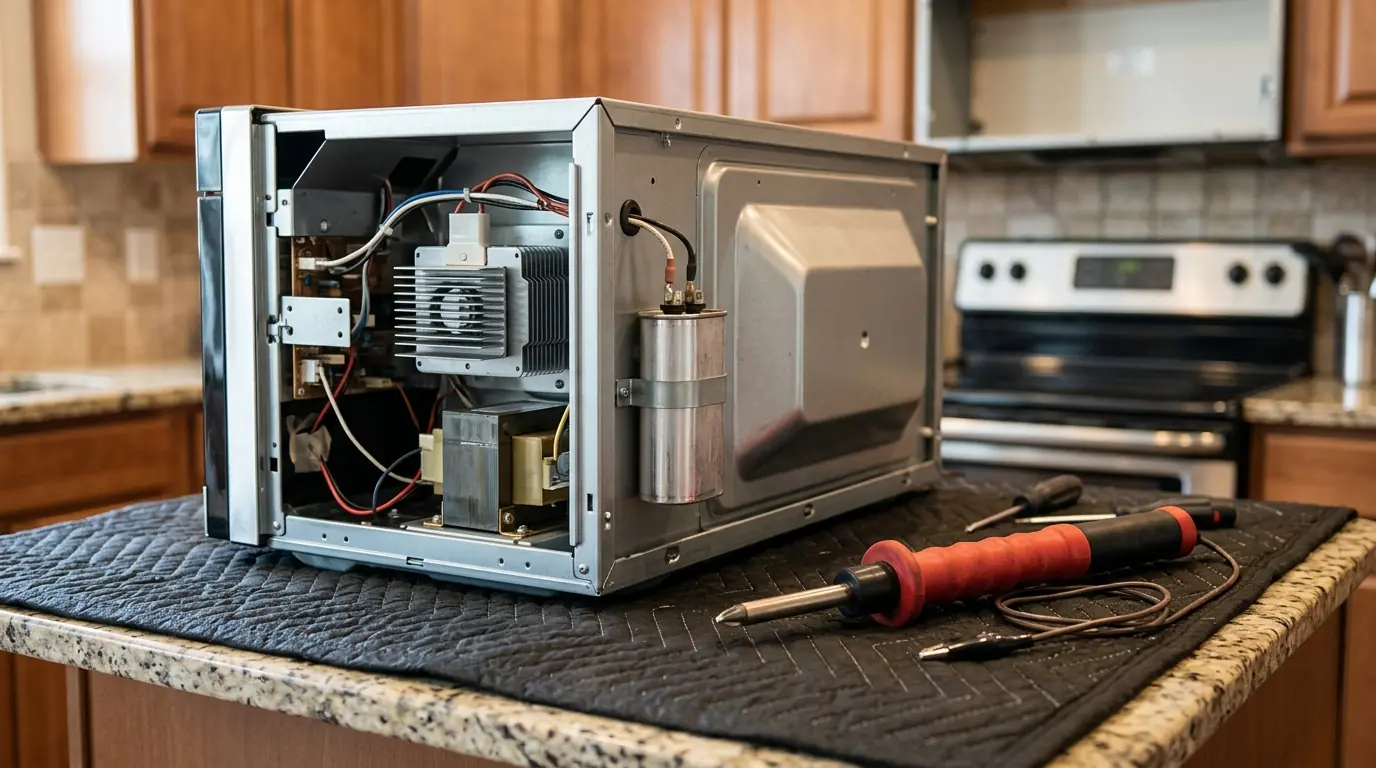
Microwave repair in South Bend most often fixes a failed magnetron, high-voltage diode or capacitor, a blown fuse from a bad door interlock switch, or a turntable, light or vent fan fault. We discharge the high-voltage capacitor before testing, then repair or advise replacement based on cost.
The problem
Microwave Repair in South Bend: What Usually Goes Wrong
Inside a microwave, a transformer, a high-voltage capacitor and a diode feed the magnetron, which makes the microwaves. A set of door interlock switches makes sure nothing runs with the door open, and a monitor switch blows the main fuse if an interlock fails closed. Most no-heat and dead-unit faults land on those parts.
For an inexpensive countertop microwave, repair rarely makes sense, and we'll say so. Over-the-range, built-in and drawer units cost more to replace and install, and their mounting, venting and trim are worth keeping. That is where most of our microwave repairs happen. We work on Whirlpool, GE, Samsung, LG, Frigidaire, KitchenAid, Bosch and Sharp units.
Cost factors
Repair or Replace: What Drives Microwave Repair Cost
This Old House reports microwave repair at $50 to $400, average about $200, as a national planning range, not a quote from us. Whether that's worth spending depends mostly on what kind of microwave you have.
Dollar figures are typical national planning ranges reported by This Old House appliance repair cost guide. They are not a quote and not our price; your cost depends on the diagnosis.
Countertop versus installed
A countertop unit is often cheaper to replace than to repair. Over-the-range, built-in and drawer units carry installation and trim costs that make repair worthwhile.
Which high-voltage part
A diode, fuse or door switch is inexpensive. A magnetron or control board sits at the top of the range.
Removal and remounting
An over-the-range unit that must come down for the repair adds labor for the lift, the bench work and the remount.
Why the fuse blew
A blown main fuse always has a cause, often a failed door interlock switch. Replacing the fuse alone without finding that cause isn't a repair.
Microwave Not Heating
The turntable spins, the light is on, the fan runs, and the food stays cold. The magnetron, high-voltage diode, high-voltage capacitor and transformer are the suspects, sometimes with a thermal cutoff or thermoprotector on the magnetron. We discharge the capacitor, then test each part for continuity and shorts to ground. A burned diode is an inexpensive part. A magnetron is the expensive end, and on many countertop units it costs close to the whole microwave, which we tell you before ordering one. A shorted capacitor often takes the diode or fuse with it.
Over-the-Range Microwave Repair
An over-the-range microwave is also your range hood, so it can fail as a cooker, a fan or a light. It hangs on a wall plate and two or three bolts through the cabinet above, and it is heavy and awkward. Many repairs, such as the door switches, the vent fan motor and the control board, require taking it down. We remove it with two people or a support, repair it on a padded surface and remount it on the plate.
Turntable, Light and Fan Faults
A turntable that stops usually has a broken coupler under the tray or a failed turntable motor. A dark interior can be a burned bulb or LED, a bad socket or a door switch that no longer signals the light. Over-the-range models have a vent fan and a cooling fan; a cooling fan that quits lets the magnetron overheat and trip its thermal cutoff. We test each motor and socket, replace what failed and confirm airflow through the vents before the unit goes back up.
Built-In and Drawer Microwaves
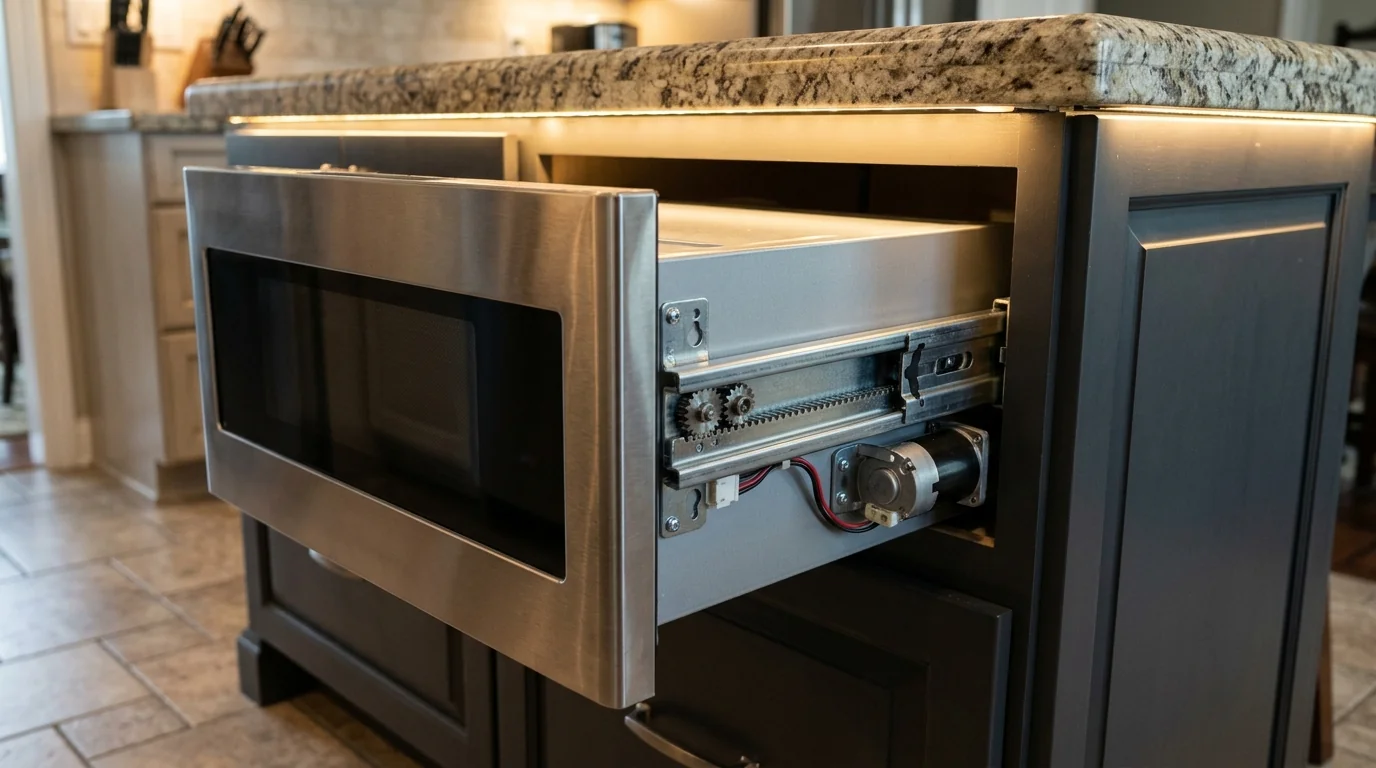
Built-in microwaves sit inside a trim kit in a wall or cabinet, often above a wall oven, and drawer microwaves sit below the counter and open like a drawer. Both have to be slid out of their openings for most repairs. Drawer units add a drawer motor, gear rack and latch that can jam or strip. We support the unit during removal, protect the trim kit and cabinet face, and test the drawer drive before reinstalling. A trim kit that was bent during an earlier removal gets straightened so the unit seats flush again.
Any hour
Microwave Repair problem right now?
Call and tell us what the appliance is doing. Phones are answered day and night, and we will get a technician scheduled.
Before you call
Microwave DIY: The Safe Checks and the Real Hazard
Safe to check yourself
- Check the outlet and breaker, and reset a tripped GFCI if the microwave shares one.
- Make sure the door closes fully and latches; a misaligned door stops the cycle.
- Reseat the turntable coupler and tray, and clean grease filters on over-the-range models.
- Run a timed cup of water to confirm whether it heats at all.
Leave these to a technician
- Never open the cabinet: the high-voltage capacitor can hold a dangerous, potentially lethal charge even after the microwave is unplugged.
- Magnetron, diode, transformer and capacitor testing, which needs proper discharge and the right meter.
- Door interlock switch replacement, since a wrong switch can let the unit run with the door open.
- Taking an over-the-range unit off its wall plate, which is a two-person lift.
Local conditions
Why This Repair Looks Different in South Bend
South Bend's median home was built in 1955, so many kitchens here predate built-in microwaves entirely. When we take down an over-the-range unit in an older house, we often find it was added later under a cabinet and over an existing range, venting through an older duct or recirculating. We check the cabinet bolts, the wall plate and the plug behind it while it's down, so the remount is solid and the vent fan actually moves air.
Step by step
How We Repair a Microwave Safely
Confirm the symptom
We heat a cup of water for a timed run and watch the turntable, light and fan, and read any error code.
Unplug and discharge
With the unit unplugged and the cover off, we discharge the high-voltage capacitor through a resistor before touching anything else inside.
Test the high-voltage path
The magnetron, diode, capacitor, transformer and each door interlock switch get continuity and short-to-ground checks with a meter, one part at a time.
Repair and verify
After replacing the part, we reassemble, check door alignment and latching on every interlock, and rerun the timed water heating test.
Warning signs
When a Microwave Should Not Be Used
Sparking or arcing inside
Arcing can come from metal in the cavity, a damaged waveguide cover or chipped cavity paint. Stop using it until it's checked.
Burning smell or smoke
Unplug it right away. Burned waveguide covers and overheated components need inspection before the next use.
Runs with the door open
Unplug it and don't use it. The interlock system has failed.
Loud buzz with no heat
A buzzing transformer or failing magnetron can overheat other parts if you keep trying.
Door doesn't seal or is bent
A damaged door or hinge can affect how safely it contains microwaves.
Brands we repair
- Whirlpool
- Maytag
- KitchenAid
- GE
- Frigidaire
- Samsung
- LG
- Bosch
- Electrolux
- Amana
- JennAir
- Sub-Zero
- Wolf
- Speed Queen
FAQ
Microwave Repair Questions From South Bend Homeowners
Usually one part in the high-voltage path has failed: the magnetron, the high-voltage diode, the capacitor or the transformer, or a thermal cutoff on the magnetron. These parts carry dangerous voltage even unplugged, so testing should be left to a technician who discharges the capacitor first.
Often, yes. An over-the-range unit costs more to buy and install, needs a matching wall plate and cabinet fit, and doubles as your range hood. A fan, light, door switch or diode repair is usually well worth it. A magnetron or control board on an older unit is closer to a toss-up.
A failed door interlock switch is a frequent cause: the monitor switch is designed to blow the fuse if an interlock fails closed. Shorted capacitors, diodes or magnetrons can blow it too. Replacing the fuse without finding the cause usually means another blown fuse.
Yes. Drawer microwaves use a small motor, a gear rack and a latch to open and close. A jammed rack, stripped gear, failed motor or a switch that no longer senses the drawer position are all repairable parts. We slide the unit out of its opening to reach them.
Usually, if the plate is the right one for the model and still anchored firmly to wall studs. In older South Bend homes, units were often added later, so we check the plate, the cabinet bolts and the outlet above before remounting. If the plate doesn't match, the new unit's plate goes up instead.
Related repairs
More Ovens, Ranges & Cooktops Repairs We Handle
Phones answered 24/7
Microwave Humming but Not Heating?
Unplug it, don't open the cover, and give us a call. We answer 24/7 and will tell you honestly whether repair beats replacement for your model.