Repair an aging appliance when the failed part is available, the repair is a modest share of a comparable new unit, and the rest of the machine is sound. Replace it when the fault is a major component on a worn machine, parts are discontinued, or a second failure is close behind. A diagnosis tells you which case you're in.
Start With the Diagnosis, Not the Age
Age is the first thing most people think about, and it matters, but it isn't the deciding factor on its own. A twenty-year-old range with a failed bake element is often a cheap, quick fix that buys years of use. A much younger refrigerator with a sealed system leak can be a poor candidate for repair. The question isn't how old the machine is. It's what failed, what it costs to fix, and what shape everything else is in.
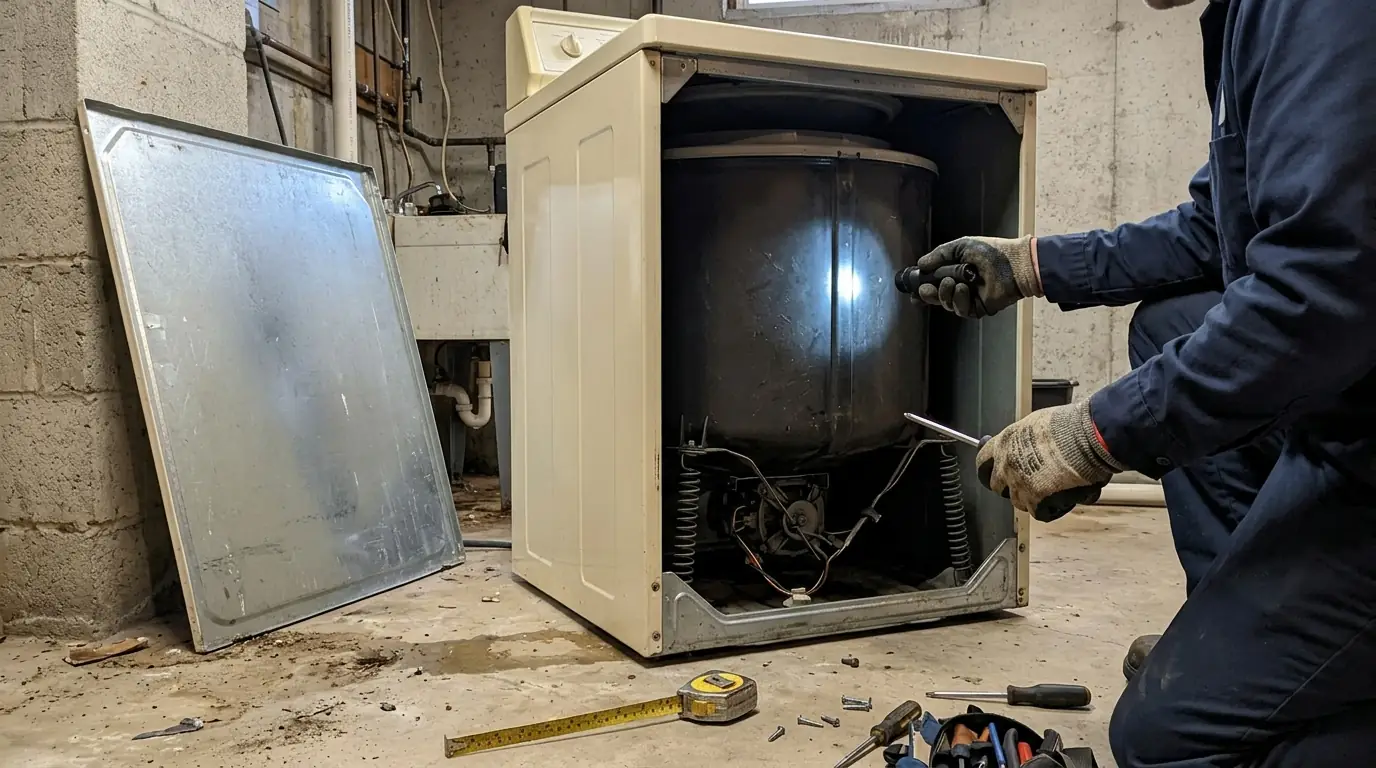
That's why we treat the diagnostic visit as the decision point. Once we know the failed part, we can tell you whether it's a wear item, like a belt, igniter or door gasket, or a core component like a compressor, transmission or outer tub. Wear items are meant to be replaced. Core components failing on an older unit is a different conversation.
Compare the Repair to a Comparable New Unit
The most useful comparison is repair cost against the price of a new appliance with similar features, plus delivery and installation. Comparing a repair on your counter-depth French-door fridge to the cheapest top-freezer model on a store flyer isn't fair to the repair.
Many technicians and homeowners use a rough rule of thumb: if the repair approaches half the cost of a comparable replacement on an older machine, replacement deserves a serious look. Treat that as a starting point, not a law. A repair at a third of the price on a well-kept machine is usually a good bet. The same repair on a machine that's rattling, rusting and leaking somewhere else is not.
- Get the repair figure after diagnosis, parts and labor included
- Price a comparable new unit, including haul-away and any new hoses, cords or connectors
- Add anything the new unit would need in your house, such as a new water line or outlet change
- Then ask what else on the old machine is showing wear
Part Availability Can Make the Decision for You
Manufacturers stop supplying parts for older models, and some electronic parts disappear first. Control boards, touchpads and inverter boards are the usual problem. When a board is discontinued we may still be able to find a refurbished one or test whether a cheaper sensor or relay is the real fault, but sometimes there is simply no part to install.
Mechanical parts like igniters, elements, fans, valves and belts tend to stay available far longer, often through generic or cross-referenced versions. So a machine with a mechanical failure usually stays repairable longer than one with an electronic one. Having your model and serial number ready lets us check availability before we commit to a path.
Phone us to get a technician out for a diagnosis, and you'll have the failed part, the repair option and an honest opinion before you shop for a new machine.
Look at the Rest of the Machine
We don't just look at the broken part. On a washer we check the tub bearing for noise and play, the suspension, the door boot and the hoses. On a refrigerator we listen to the compressor, check the door gaskets with a dollar-bill test and look at frost patterns. On a range we look at the door hinges, the oven gasket and the condition of the burners and valves.
If one part has failed and everything else is solid, repair makes sense. If we see a second failure coming, we'll tell you plainly so you can decide with the full picture rather than paying for one repair now and another in a few months.
Efficiency and Features: Real Gains and Overstated Ones
Newer refrigerators, freezers and washers generally use less energy and water than models from a couple of decades ago, and that can tilt the decision on an old, inefficient unit you run every day. A basement second fridge that's running constantly is the classic example. It's worth checking the Energy Guide label on a comparable new model to see the estimated yearly use.
Efficiency is a weaker reason to replace an oven, cooktop or dryer, where the gains are smaller. And features cut both ways. Electronics-heavy machines can be more expensive to repair later. Replace for a feature you'll actually use, not just because the new model has a screen.
South Bend Houses Add a Few Extra Questions
The median home in South Bend was built in 1955, and many are older. In those houses, replacing an appliance can mean extra work the price tag doesn't show: a new range may not fit an older cutout, a modern dryer may need a different cord to match the outlet, a new refrigerator may need a fresh water line and shutoff, and older laundry rooms can be tight for larger front-load machines.
None of that is a reason to avoid replacing. It's a reason to measure first and include those costs when you compare. Sometimes the space itself is the strongest argument for keeping a machine that fits and repairing it.
Quick Signals for Each Choice
After many service calls, a few patterns hold up well. They won't replace a diagnosis, but they're a fair way to frame what you're likely to hear.
- Usually repair: igniters, elements, belts, door gaskets, drain pumps, inlet valves, door switches, fan motors
- Weigh carefully: control boards, washer bearings, dishwasher circulation pumps, ice maker assemblies
- Often replace on an older unit: compressor or sealed system failures, cracked washer outer tubs, rusted-through cabinets, discontinued boards
- Replace for safety: a gas appliance with corroded valves or a unit with melted wiring at the terminal block
Related repairs
Repairs This Guide Covers
FAQ
More Questions on This Topic
It's a reasonable starting point, not a firm rule. The idea is that when a repair approaches half the price of a comparable new unit on an older machine, replacement deserves a look. But condition matters more than the ratio. A well-kept machine with a single failed part can be worth a bigger repair; a worn one with other faults may not be worth a small one.
Ask the technician whether the discontinued part is really the cause, since a sensor or relay can mimic a board failure. If the board truly failed, refurbished or repaired boards are sometimes available. If nothing can be sourced, replacement is usually the only path. Having the model and serial number when you call lets us check availability early.
Often it does, especially when the old unit is a second fridge in a basement or garage running all the time. The way to know for your case is to compare the yearly energy estimate on a new model's Energy Guide label against your current fridge. Worn door gaskets and dirty condenser coils on the old unit also raise its use, and those are cheap fixes.
Yes, and it's often money well spent. The visit tells you exactly what failed, whether the part is available, what the repair would involve and what else on the machine is wearing. Even if you replace, you'll know whether the problem was the appliance or something in the house, such as a water supply, outlet or vent issue that would affect the new unit too.
Treat it the same way, with one extra step: find the model and serial number and look up its age and recall status. Older homes in the South Bend area often come with appliances of unknown history. A diagnosis on the one that failed, plus a quick look at gaskets, hoses and connections on the others, gives you a sound plan for the whole kitchen and laundry.