When a gas oven won't heat but the cooktop burners light, the bake igniter is the most common cause. A hot-surface igniter can still glow while drawing too little current to open the oven's gas valve. Other suspects are the safety valve, temperature sensor and control. If you smell gas, stop, leave the house and call the gas utility.
If You Smell Gas, Stop Here
Everything else in this guide assumes there's no gas odor. If you smell rotten eggs near the range or anywhere in the house, don't turn anything on or off, don't light a match, and don't use a phone near the smell. Leave the house and call your gas utility's emergency line from outside. Once the utility has made the area safe, we can diagnose and repair the range.
A brief, faint whiff right as the oven lights can be normal on some models. A persistent smell, or one that lingers after the oven is off, is not.
How a Gas Oven Lights
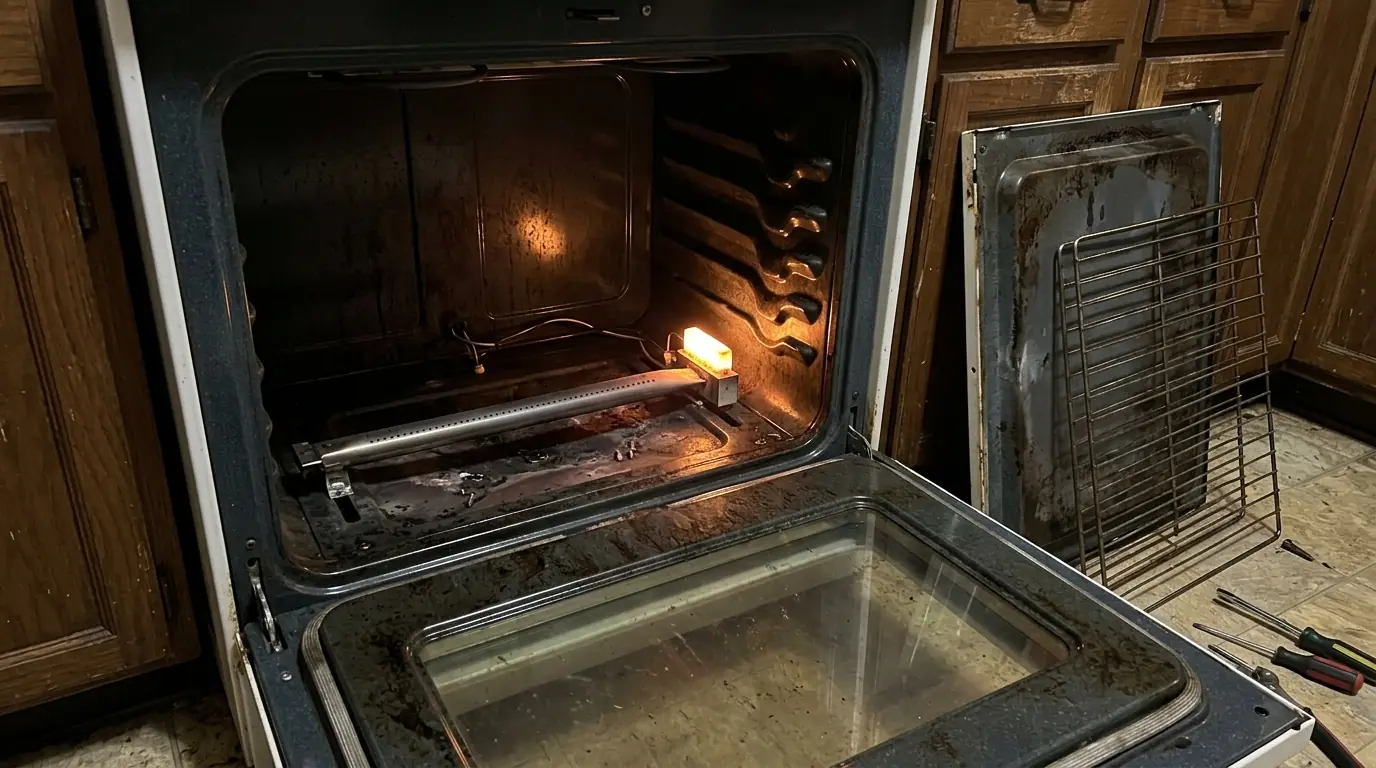
Most gas ovens built in the last few decades use a hot-surface igniter, often called a glow bar. When you turn on bake, the control sends power through the igniter. As it heats, its resistance drops and the current through the circuit rises. That current also passes through a bimetal safety valve. Only when the current reaches the valve's opening threshold does the valve let gas flow to the burner, where the glowing igniter lights it.
That design is deliberately fail-safe: no strong igniter, no gas. It also explains why the igniter is such a common failure point. As igniters age, their resistance creeps up. Eventually they glow orange but never pass enough current to open the valve, and the oven sits there glowing without lighting.
The Glow Test You Can Do Safely
You can learn a lot without removing a single screw. Take out the oven racks and the bottom panel if it lifts out without tools, or look through the slots. Set the oven to bake and watch the igniter at the burner.
- No glow at all after a minute or two: igniter open, or the control isn't sending power
- Glows but no flame after 90 seconds or more: weak igniter is the most likely cause
- Lights, then shuts off and won't relight: often a weak igniter or a temperature sensor fault
- Bake works but broil doesn't, or the reverse: each burner usually has its own igniter
- Burners on the cooktop don't light either: check power to the range, the gas supply valve, and the utility service
If the igniter glows but the oven never lights, phone us at any hour and we'll get a technician out to test it and the valve properly.
Other Usual Suspects After the Igniter
If the igniter tests good, we move on. The oven safety valve can fail, though less often. The temperature sensor, a thin probe on the back wall, tells the electronic control how hot the oven is; if it reads wrong, the oven may underheat, overheat or shut off. The control board or a relay on it can fail to power the igniter at all. A loose or burnt wire connector behind the range is another cause we see.
On self-cleaning ovens, a stuck door lock can block bake from starting after a clean cycle. And on older ranges, an oven that won't hold temperature but lights fine may simply need calibration or a new door gasket.
Why Igniter and Valve Work Belongs to a Technician
Replacing an igniter means working at the burner assembly inside a gas appliance, disconnecting and reconnecting wiring, and often handling the gas valve area. Some igniters are sold in different current ratings, and fitting the wrong one can leave the valve closed or make it cycle unpredictably. We confirm the igniter with an amp reading against the valve's rating, not just by looking at the glow.
If the range has to be pulled out, the flexible gas connector is disturbed, and every connection we touch gets checked with leak solution before we leave. In older South Bend homes, where the median house dates to 1955, we sometimes find a corroded or very old connector behind the range; if so, we'll recommend replacing it while the range is out.
What Repairs Typically Run
This Old House reports oven repair at $100 to $400 nationally, with an average of about $300, and Inch Calculator reports gas or electric range repair at $100 to $600. Use these as planning ranges. An igniter replacement usually falls well within them. A control board on a newer range, or a wall oven that has to come out of the cabinet, tends to sit higher.
Keep the Oven Lighting Reliably
Igniters are fragile ceramic parts. Avoid bumping them when cleaning, and don't spray oven cleaner onto the burner area or the temperature sensor. Keep the burner ports clear of spills; a burner that lights unevenly or with a lazy yellow flame needs attention. If your oven takes noticeably longer to light than it used to, that slow start is often the igniter warning you before it quits entirely.
Dollar figures are typical national planning ranges reported by This Old House appliance repair cost guide and Inch Calculator appliance repair cost guide. They are not a quote and not our price; your cost depends on the diagnosis.
Related repairs
Repairs This Guide Covers
FAQ
More Questions on This Topic
An aging hot-surface igniter can glow while drawing too little current to open the oven's safety valve. The valve needs a specific amperage before it lets gas through, so a weak igniter leaves you with a bright glow and no flame. This is the single most common cause of a gas oven that won't heat. The fix is a correctly rated igniter, confirmed with an amp reading.
With a hot-surface igniter, it's normal for the burner to light anywhere from about 30 seconds to a minute or more after you press bake, since the igniter has to heat up first. Check your range manual for its stated range. If it's taking noticeably longer than it used to, or sometimes doesn't light at all, the igniter is likely weakening.
If the cooktop burners light normally, gas is reaching the range, so the supply is usually not the issue. The oven has its own igniter, safety valve, temperature sensor and control circuit, and any of those can fail while the cooktop keeps working. The most common culprit by far is the bake igniter. Check for gas odor first, then try the glow test.
Some homeowners do, but we recommend a technician. The job involves working inside a gas appliance near the safety valve, and igniters come in different current ratings; the wrong one can keep the valve shut or cause erratic lighting. If the range is pulled out, the gas connector should be leak tested afterward. A pro can also confirm the igniter was actually the fault.
It's normal for the burner to cycle off when the oven reaches temperature and relight as it cools. If it goes out and won't relight, or the oven never reaches temperature, a weak igniter is a likely cause, followed by a faulty temperature sensor or control relay. An oven thermometer on the middle rack helps show whether it's cycling normally or failing.