When a dishwasher leaves dishes dirty or spotty, start by cleaning the filter, clearing the spray arm holes and running the kitchen tap hot before a cycle. In South Bend, very hard city water, about 19 to 24 grains per gallon, causes much of the white film and spotting. If those fixes fail, the pump, inlet valve or heater may need a technician.
Dirty Versus Spotty: Two Different Problems
It helps to separate the two complaints. Food left stuck on plates, grit on glasses and greasy residue usually means the water isn't reaching the dishes with enough force or heat. White spots, a cloudy haze and chalky film that won't wipe off usually mean minerals are drying onto the surface.
Plenty of kitchens have both, because the same hard water that leaves spots also narrows spray arm holes and coats the heater. But figuring out which symptom dominates tells you where to start.
Clean the Filter First
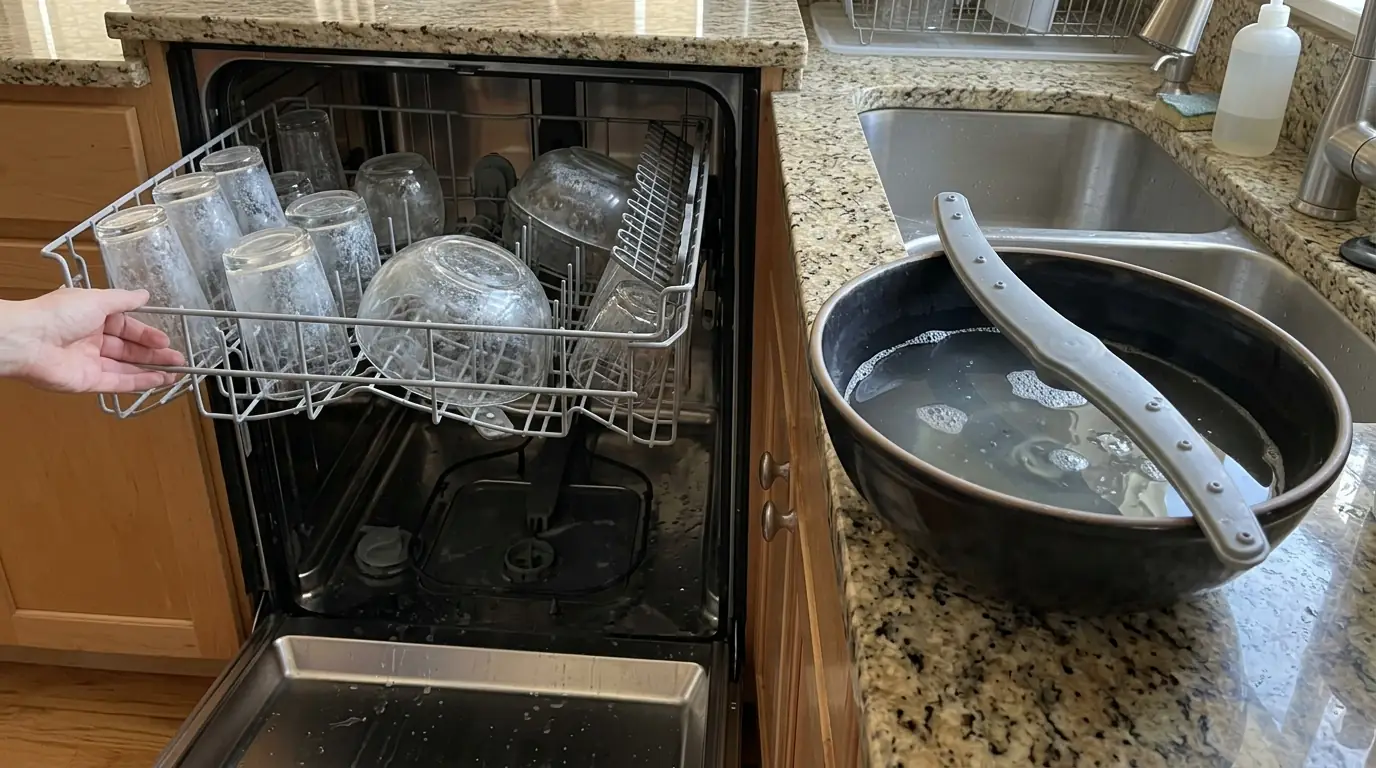
Most dishwashers made in the last decade or so have a manual filter under the lower spray arm, and many owners don't know it's there. When it clogs, dirty water recirculates and redeposits food on the dishes. A smell from the tub is another clue.
Twist the cylindrical filter out, lift out the flat mesh beneath it, and rinse both under warm water with a soft brush. Don't use a wire brush, which can tear the mesh. Wipe out the sump area, reinstall the filter until it locks, and run a cycle. In many kitchens this alone fixes the problem.
Spray Arms, Loading and Water Temperature
Pull out the lower and upper spray arms and look at the small holes. Scale and bits of food often block several of them. Soak the arms in warm white vinegar, then clear each hole with a toothpick, and check that they spin freely once reinstalled. A tall pan handle that stops an arm mid-rotation will leave a whole rack dirty.
Water temperature matters more than people think. Dishwashers rely on hot water to dissolve detergent and grease. Before starting a cycle, run the kitchen sink tap until the water is hot so the machine fills with hot water instead of what's been sitting in the pipe. Use the heated wash or high-temp option for heavily soiled loads.
- Face dirty surfaces toward the center and the spray arms
- Don't nest bowls or block the detergent dispenser door
- Check that the upper arm isn't blocked by a tall item on the lower rack
- Use fresh detergent; old pods and powders lose strength
If clean filters and clear spray arms haven't solved it, give us a call and we'll get a technician out to test the pump, valve and heater.
How South Bend's Hard Water Leaves Film and Spots
The City of South Bend reports average hardness of 330 to 410 mg/L as calcium carbonate, or 19 to 24 grains per gallon, varying with which wells are in use. That's very hard water, and a dishwasher heats and evaporates a lot of it. The calcium and magnesium are left on glasses as cloudy spots and on the tub as a white crust.
Three things help most. Keep the rinse aid dispenser full, since rinse aid helps water sheet off instead of drying in droplets. Run a descaling cleaner or a cup of white vinegar on the top rack through a hot empty cycle about once a month. And if you have a softener, make sure it's set at or above the city's suggested starting point of 19 grains per gallon and actually regenerating.
Is It Film or Etching?
Try this on a cloudy glass: soak it in white vinegar for a few minutes. If the cloudiness comes off, it's mineral film, and the hard water steps above will help. If it doesn't, the glass may be etched, a permanent roughening of the surface. Etching is more common when very soft water meets too much detergent, which can happen after a new softener is installed and detergent amounts aren't reduced. Etched glassware can't be restored, but you can prevent more of it by adjusting detergent.
When the Problem Is Inside the Machine
If the filter is clean, the arms spin with clear holes, the water is hot and dishes are still dirty, look for mechanical faults. A tub that only fills partway suggests a scaled or failing inlet valve. A weak hum during washing with little spray noise points to a circulation pump or wash motor. Dishes that come out cold and wet may mean a failed heating element or thermostat. A detergent cup that doesn't open, or opens late, wastes the detergent.
Those repairs involve line-voltage wiring and work under and behind the tub, so they're for a technician. We measure fill volume, test the inlet valve coil and heater with a meter, and check the pump's wash pressure. This Old House reports dishwasher repair at $100 to $300 nationally, averaging about $220, which is a useful planning range for most of these parts.
Dollar figures are typical national planning ranges reported by This Old House appliance repair cost guide. They are not a quote and not our price; your cost depends on the diagnosis.
Related repairs
Repairs This Guide Covers
FAQ
More Questions on This Topic
For most households, every two to four weeks is a good rhythm, and more often if you don't pre-rinse heavily soiled dishes. A clogged filter recirculates dirty water and redeposits food on clean dishes, and it's the most common cause of gritty results. If you notice a smell or standing water in the bottom of the tub, check it right away.
Most likely the hard city water, which averages 19 to 24 grains per gallon. A new dishwasher can't stop minerals from drying on glass. Keep rinse aid filled, use a detergent formulated for hard water, and run a monthly descaling cycle. If cloudiness doesn't come off with a vinegar soak, the glasses may be etched rather than filmed.
Not necessarily. Most dishwashers do well with water arriving at about 120F, which is a common water heater setting, and many models heat the water further during the wash. Running the kitchen tap until it's hot before starting the cycle usually helps more than raising the heater temperature, which also increases scald risk at faucets.
Many pods and powders contain water softening ingredients that help in hard water, while some gels have less. Results vary by brand and water, so it's worth trying a pod or powder labeled for hard water if you're seeing film. Whatever you use, keep rinse aid filled; it does more for spotting than switching detergent types.
That pattern usually points to the lower spray arm: clogged holes, a crack, or something blocking its rotation like a tall pan handle or a utensil dropped through the rack. Pull the arm, clean the holes, and spin it by hand once it's back in. If it spins freely and the bottom is still dirty, the pump may be weak.